
Water Softeners and Water Treatment in Collin County, TX
The North Texas Municipal Water District calls its water moderately hard and credits the minerals in Lavon Lake. Plano, McKinney, Allen and Frisco, the Collin County cities we list, all belong to the district.
Get your free water testWhere We Install in Collin County
We install softeners, filtration and drinking water systems across Collin County, including these cities.
- Plano,
- McKinney,
- Frisco,
- Allen
Water in Collin County
The district serves more than 2.4 million people across 2,200 square miles through 13 member cities and 34 customer cities and utilities. Its supply list runs from Lavon Lake, inside Collin County, to Lake Texoma, Lake Tawakoni and Jim Chapman Lake, originally named Cooper Lake. The district fully owns and operates Bois d'Arc Lake in Fannin County, and its East Fork Water Reuse Project, a wetland, pulls water from the East Fork of the Trinity River.
NTMWD Wylie plant
5.6 to 11.7grains per gallon (approx.)
96.0 to 200 ppm, 2025; supplies Plano and Frisco
NTMWD Leonard plant
5.6 to 8.4grains per gallon (approx.)
96.0 to 144 ppm, as printed in Frisco's 2025 report
North Texas Municipal Water District
Plano and McKinney were among the district's ten original member cities; Allen joined in 1998 and Frisco in 2001. At the Wylie plant, 2025 hardness ranged from 96.0 to 200 ppm. The top of that range is past the 180 ppm line where the U.S. Geological Survey starts calling water very hard.
Frisco's 2025 report says the district treats with ozone and free chlorine, then adds ammonia to form chloramines, and switches to chlorine for about a month each spring.
Frisco
Frisco buys from the Wylie plant. Its 2025 report lists highs of 61.3 ppm calcium, 9.44 ppm magnesium and 455 ppm total dissolved solids for Wylie water, and a chloramine residual of 2.16 ppm for Frisco, with samples from 0.3 to 3.86 ppm.
Plano
Plano draws on the Wylie plant too. Our Plano page covers its supply, from hardness to iron and odor compounds.
City Water vs. Well Water in Collin County
Homes outside city systems may draw from private wells, which no utility treats or tests.
Groundwater Rules in Collin County
The North Texas Groundwater Conservation District's boundaries match Collin, Denton and Cooke counties, and its 2012 management plan refers to the Northern Trinity and Woodbine aquifers in the district. The Texas Water Development Board says the Woodbine's upper zone yields limited water that tends to be very high in iron.
When to Test a Well
TCEQ does not regulate private drinking water wells, so testing falls to the owner. The EPA says to test right away if you notice a change in odor, color or taste, and every year for total coliform bacteria, nitrates, total dissolved solids and pH.
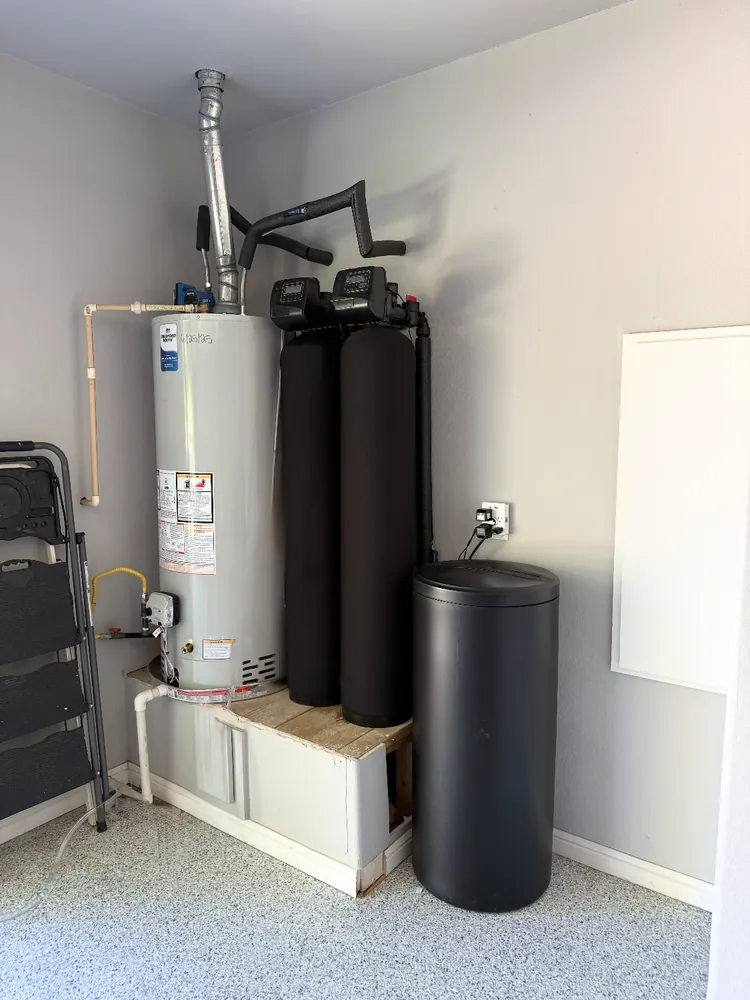
What Collin County Homes Usually Need
The district states that its water is safe to drink and use without filtration, so home treatment here is a choice about hardness, scale and preference. We test, then recommend, with no pressure to buy.
Water Softeners
The Wylie plant's water reached 200 ppm in 2025. A softener stops scale on your water heater, dishwasher and fixtures.
Whole-Home Filtration
Removes iron and sediment at the point of entry for the whole house.
Drinking Water Systems
An under-sink reverse osmosis system for drinking and cooking water.
Well Water Treatment
The water board says the Woodbine's upper zone tends to be very high in iron. We test your well and build treatment around what we find.
Collin County Water Questions
Is Collin County water hard?
The North Texas Municipal Water District calls it moderately hard, mainly because of minerals in Lavon Lake. Its Wylie plant ranged from 96.0 to 200 ppm in 2025, about 5.6 to 11.7 grains per gallon.
Where does Collin County tap water come from?
Plano, McKinney, Allen and Frisco get it from the North Texas Municipal Water District, which draws on Lavon Lake, Lake Texoma, Bois d'Arc Lake, Jim Chapman Lake, Lake Tawakoni and the East Fork Water Reuse Project.
Does the disinfectant change during the year?
Yes. Frisco's 2025 water quality report says the district switches from chloramines to chlorine for about a month each spring.
Who oversees groundwater in Collin County?
The North Texas Groundwater Conservation District, whose boundaries match Collin, Denton and Cooke counties. TCEQ does not regulate private drinking water wells, so owners maintain and test their own.
Sources
- NTMWD: Water System
- NTMWD: History
- NTMWD: Protecting Our Drinking Water
- NTMWD: Water Hardness Fact Sheet
- NTMWD: 2025 Water Quality Report
- City of Frisco: 2025 Annual Water Quality Report
- North Texas GCD: Management Plan (2012, hosted by TWDB)
- Texas Water Development Board: Woodbine Aquifer
- TCEQ: Groundwater contamination notification, what you need to know
- EPA: Protect your home's water
- USGS: Hardness of Water
Book a Free In-Home Water Test
Free in-home water tests are available for homes in Collin County and across Dallas-Fort Worth.
What happens next
- 1We test your waterIn your home, for hardness, chlorine, iron, and sediment.
- 2We recommend a systemA softener, filtration, reverse osmosis, or a combination. No pressure to buy.
- 3We install itClean, and we walk you through how it works.